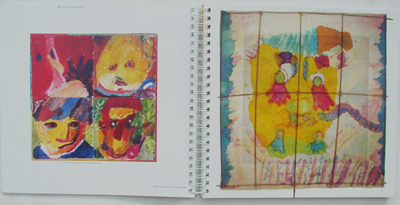
The Dutch AllaprimA Foundation has a huge collection of children's paintings
and drawings.
The collection is de result of the art teaching in the art school AllaprimA Art Atelier in Zwijndrecht the Netherlands.
During more than 30 years the artist and art teacher Marja de Jong has teach
hundreds of children and adults.
The lessons are based on essential artistic principals, visible in the quality
of the works.
The AllaprimA Foundation has given the use of the collection to the AllaprimA
MuseuM of art centre Saksala ArtRadius to be sure it will be more public.
Recommendation by Willem Beerman (NL)
Art Teacher's Department,
Hogeschool Rotterdam
“Marja was a fantastic good art teacher in the Rotterdam area. Especially with a
large group of children which she coached during almost 20 years. She made a
great impression with exhibitions and lectures during the Rotterdam Insea
congress in 1981, de Zonnehof in Amersfoort, the Art Teachers Annual in Gent (B)
and de Kunsthal in Rotterdam in 2001. Gradually she became the most important
art teacher for the youngest (3- 6 years) in the Netherlands and her influence
in the circle of "Kindergarten- educators was important. When she left our
country it was a great loss for art education. Willem Beerman”
January 23, 2010
The collection is a part of the art education program, the exhibitions in the museum, and can also be used by students and scientists in the field of art and
art education.
The publications about the collection, the view on art education and the interesting results of long-term education is only in Dutch, except the last
one.
The book 'kindertekeningen, een beeldverhaal' (children's paintings, a story of images) is in two languages Dutch and English.
This book is still available, just as the method UIT DE KUNST.
Ten Lessons the Arts Teach
By Elliot Eisner
The arts teach children to make good judgments about qualitative relationships.
Unlike much of the curriculum in which correct answers and rules prevail, in the arts, it is judgment rather than rules that prevail.
The arts teach children that problems can have more than one solution and that questions can have more than one answer.
The arts celebrate multiple perspectives.
One of their large lessons is that there are many ways to see and interpret the world.
The arts teach children that in complex forms of problem solving purposes are seldom fixed, but change with circumstance and opportunity.
Learning in the arts requires the ability and a willingness to surrender to the unanticipated possibilities of the work as it unfolds.
The arts make vivid the fact that neither words in their literal form nor number exhaust what we can know.
The limits of our language do not define the limits of our cognition.
The arts teach students that small differences can have large effects.
The arts traffic in subtleties.
The arts teach students to think through and within a material.
All art forms employ some means through which images become real.
The arts help children learn to say what cannot be said.
When children are invited to disclose what a work of art helps them feel, they must reach into their poetic capacities to find the words that will do the job.
The arts enable us to have experience we can have from no other source and through such experience to discover the range and variety of what we are capable of feeling.
The arts’ position in the school curriculum symbolizes to the young
what adults believe is important.
SOURCE: Eisner, E. (2002). The Arts and the Creation of Mind, In Chapter 4, What the Arts Teach and How It Shows. (pp. 70-92). Yale University Press.
Available from NAEA Publications.
NEWSPAPER NRC (NL) edition 14.4.2008
NEWS THEME EDUCATION Graham Lock: Most of the people do not need much knowledge
The article is a critical view on the Dijsselbloem report about the Dutch
education system.
The end of the article tells about: What was the original reason of education?
"Traditional education is focusing on the individual. What does he need, not
that so much for the labor market, but to live a meaningful life as a human.
Gain knowledge of history, science and philosophy, not because you want to have
a job in it, but because you need a repertoire to drawn on in unexpected moments"
Ken Robinson says schools kill creativity, an interesting view on education and
creativity.
Bring on the learning revolution
In 2006 I spoke at TED about developing children’s natural powers of
creativity and imagination. Returning to TED in 2010 I wanted to focus on the
need for a radical shift in education more generally. Reforming education is
rightly seen as one of the biggest challenges of our times. In my view, reform
is not enough: the real challenge is to transform education from a 19th century
industrial model into a 21st century process based on different principles.
Current systems of education are based on the manufacturing principles of
linearity, conformity and standardization. The evidence is everywhere that they
are failing too many students and teachers alike. A primary reason is that human
development is not linear and standardized, it is organic and diverse. People,
as opposed to products, have hopes and aspirations, feelings and purposes.
Education is a personal process. What and how young people are taught have to
engage their energies, imaginations and their different ways of learning.
In this talk, I make a passing reference to fast food. Let me elaborate briefly.
In the catering business, there are two main methods of quality assurance. The
first is standardizing. If you have a favorite fast food brand, you can go to
any outlet anywhere and know exactly what you will find: same burger, fries,
cola, décor, and attitudes. Everything is standardized and guaranteed. By the
way, this “cheap” food is also contributing to the most costly epidemic of
diabetes and obesity in human history. But at least the standards are
guaranteed.
The other method of quality assurance are the star ratings guides, like
Michelin. These methods do not prescribe what’s on the menu, when restaurants
should open, or how they should be decorated. They set out criteria of
excellence and it’s up to each restaurant to meet them in their own way. They
can be French, Mexican, Italian, Indian, American or anything else. They can
open when they choose, serve what they like and hire whom they want. In general
they are much better than fast food and offer a higher standard of service. The
reason is that they are customized to local markets and personalized to the
people they serve.
Education reform movements are often based on the fast food model of quality
assurance: on standardization and conformity. What’s needed is a much higher
standard of provision based on the principles of personalized learning for every
child and of schools customizing their cultures to meet local circumstances.
This is not a theory. There are schools everywhere that demonstrate the
practical power of these principles to transform education. The challenge is not
to take a single model to scale but to propagate these principles throughout
education so that teachers, parents, students and principals develop their own
approaches to the unique challenges they face in their own communities.
Standardization tends to emphasize the lowest common denominator. Human
aspirations reach much higher and if the conditions are right they succeed.
Understanding those conditions is the real key to transforming education for all
our children.


 ALLAPRIMA MUSEUM


derekphwong - uploader of the movie on YouTube -
Child's creativity is enormous, but what's the boundary? What about rules?